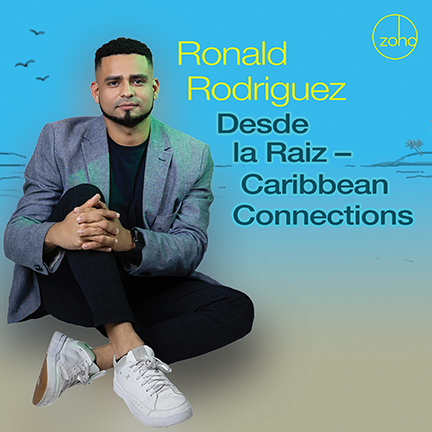
Ronald Rodriguez has many musical heroes. Johann Sebastian Bach and Franz Joseph Haydn are among them, as are Gonzalo Rubalcaba, Tito Puente, and other masters who understood how structure and rhythm can work together. These influences may come from different periods and traditions, but Rodriguez hears what connects them. He is interested in form, counterpoint, clave, swing, and the many ways a musician can take something familiar and make it sound fresh.
That is the central idea behind Desde La Raíz: Caribbean Connections. The title means “from the root,” and Rodriguez starts with the music that has shaped him most deeply. He draws from Colombia, Cuba, New Orleans, the wider Caribbean, classical music, and jazz. But this album is not a survey or history lesson. It is a personal production, made by an artist who has lived with these sounds and found his own way of bringing them together.
Born in Cartagena, Colombia, Rodriguez began playing piano at age nine. He later studied at Northwestern State University of Louisiana and Louisiana State University, where he earned graduate degrees in piano performance, jazz studies, and piano pedagogy. He built considerable experience in the New Orleans music scene, performing at the New Orleans Jazz & Heritage Festival, Snug Harbor, and the New Orleans Jazz Museum. He has also appeared with the Delfeayo Marsalis Quintet, the Uptown Jazz Orchestra, Randy Brecker, and many others.
Rodriguez is now based in Alabama, where he serves as Assistant Professor of Piano at Samford University in Birmingham. He is a performer, educator, scholar, and bandleader, and you can hear all these sides of him on this album. The arrangements are carefully considered, but the music never feels overworked. There is room for spontaneity, surprise, and personality.
Maple Leaf Rag opens the album with a bold idea. Scott Joplin’s famous piano piece is recast through the rhythmic relationship between ragtime, Cuban son, and New Orleans swing. Rodriguez keeps some of the pianistic character of the original while surrounding it with horn writing inspired by small jazz ensembles of the 1940s and 1950s. Justo Almario, the legendary Colombian reed player, appears on clarinet. His sound gives the arrangement both elegance and lift. It is a terrific beginning because it explains the album without having to explain it. The traditions meet, and the music moves.
Almario returns on Perfidia, the Alberto Domínguez Borrás bolero that has been recorded by artists from Nat King Cole to Ibrahim Ferrer. Rodriguez begins with dissonance, immediately setting a mood of longing and regret. Almario plays the melody on alto saxophone with a singing quality, then moves into a bebop-inflected improvisation. He understands both the romance of the song and the freedom within it.
Congagena is an original composition inspired by Cartagena, Rodriguez’s hometown. The title joins conga and Cartagena, and the piece itself joins memory and motion. A simple pentatonic melody gives the musicians a clear foundation, while brief bebop passages add momentum. Brent Rose, Julian Lee, David Navarro, and Rodriguez each contribute solos, and Amaury Perez closes with a strong trombone statement. The tune has the feeling of a city seen from several angles at once.
Gin Tonic, written by Rodriguez and Jair Morelos, began with a bass riff Morelos heard after a night out with his wife. That small idea became a lively piece that moves through guaguancó, samba, funk, and descarga. Morelos and Alexey Marti generate tremendous energy on percussion, while the brass figures bring a sharp, almost salsa-like edge. This is one of the album’s most enjoyable tracks. It has humor, groove, and a sense that the band is having a great time.
For Ana changes the atmosphere completely. Rodriguez wrote it for his mother, who died four years before the recording. The piece begins with an obstinate bass figure beneath shifting harmonies in the right hand. It is lyrical and restrained. Rodriguez does not overstate the emotion. He lets the melody carry the weight of remembrance. The result is one of the album’s most affecting moments.
Sonny Rollins’ Pent-Up House brings the pulse back. Inspired by Tito Puente, the arrangement has the feel of classic Latin jazz. It was recorded in one take, and you can hear the musicians responding to one another in real time. David Navarro’s trumpet solo is especially strong. He plays with force, clarity, and a deep feeling for Cuban musical language.
Bye Bye Blackbird is the only trio performance on the album. Rodriguez begins with a quiet solo piano introduction before bassist Max Moran and drummer Peter Varnado enter. The track has patience. Varnado uses the drums for color as much
|
 as timekeeping, and the trio allows the tune to unfold naturally. Someday My Prince Will Come takes a different route, moving into a modern electric setting with a Latin 6/8 feel. as timekeeping, and the trio allows the tune to unfold naturally. Someday My Prince Will Come takes a different route, moving into a modern electric setting with a Latin 6/8 feel.
Oscar Peterson’s Love Ballade is recast as a chamber-like performance featuring Spanish cellist Rebeca Lemos. Rodriguez uses colors associated with Debussy and Ravel, giving the piece a soft impressionistic quality. The arrangement also pays tribute to Peterson’s determination to continue performing after the stroke that affected his left hand. It leads beautifully into Danzón for Adolfo, a tribute to Colombian composer Adolfo Mejía. Piano, cello, and congas connect Cuban danzón with vallenato and the music of Colombia’s coast.
The title track Desde La Raiz is the album’s fullest statement. Inspired by Papo Lucca’s rendition of “Israel,” it features Almario on tenor saxophone. That appearance carries special meaning, because Almario was an early influence on Rodriguez’s interest in Latin jazz. The arrangement combines brass, congas, drums, and bass lines drawn from Cuban timba. Funk, R&B, jazz, and Afro-Cuban rhythm all appear, but the piece never loses direction.
Congagena (Ending) closes the album by returning to celebration. The conga has long been associated with Cuban street processions and carnival traditions, and Rodriguez uses it here as a final invitation. Horns, vocals, and percussion come together in a brief, joyful reprise. The album does not simply end. It gathers everyone into the rhythm.
Desde La Raíz is a confident and generous album. Rodriguez has assembled a superb international ensemble and given each musician room to speak.
It’s also a pleasure to hear a fellow Southerner making such a persuasive case for Latin jazz. From his home in Alabama, Rodriguez carries Cartagena and New Orleans with him. On this album, those places do not feel far apart. They sound like neighbors.
-Kabir Sehgal
Multiple Grammy winning producer
Production Credits:
Recorded at Esplanade Studios, New Orleans, LA on June 24, 2025. Sound Engineer, Mixing & Mastering: Misha Kachkachishvili. Liner notes: Kabir Sehgal. Photography: Yuri Gonzalez (Yuriko Photography Studios), Danny Gala. Art Direction and Package Design: Al Gold. Producers: Ronald Rodriguez, Joachim Becker. Executive Producer: Ronald Rodriguez.
|